Category: Good Living
Best thing about traveling: Spontaneity and meeting new people
To balance the melancholy of the last post, here is an opposite story. Few days after the blackouts in the beach bar, I traveled onwards to León attracted by its reputation as the capital of intellectual and cultural life of Nicaragua. Whilst there, I went to eat alone in a local bar serving food even in the late hours Having finished my meal and reading a book while waiting for the check, a Norwegian guy from a big group approached me and invited me to join them to a night club they were heading to. Having no responsibilities or schedules, I naturally welcomed the idea. Two minutes later I was packed in a van with nineteen mostly Norwegian and hilariously drunk people.
We hit the night club where I happened to sit next to a local guy. We introduced ourselves to each other and I offered to buy him a beer (it is easy to be generous when a beer costs around 1$). He didn’t speak much English but I was surprised to be able to express quite many things with my hands and the lessons learned from my 5 days long intensive introductory course to Spanish (thanks Nica Spanish Language School!). He told me about a concert the next evening and invited me to join him and his friends for a pre-party at his home.
Next evening I showed the taxi-driver the address he had given me and we drove through the streets of León towards the destination. Here the streets have no names – really – so the address was quite literally ”red house 1 block south from the basketball field”. When the paved road ended and we drove in a muddy street surrounded by run-down houses in the evening darkness not lit by streetlights I began to wonder where was I really heading. Soon I was knocking on a door of a house that looked the most red of the one’s on the street hoping that I was in the right spot. Marti, my friend, opened and invited me in.

His friends spoke more English and we shared a few beers as well as listened to some local music that they introduced to me before heading for the concert. One guy’s name was Vladimir and when I asked about it he told that his mother had been in a leftist guerrilla army while she was pregnant and wanted to name her son after Vladimir Lenin. I thought what a hero I could have been on the schoolyard when children are boasting about their parents occupations if I could have said: ’My mom is a guerrilla soldier’. I found the dramatic history of Nicaragua become concrete when I realized that all the people I was meeting here had either themselves played a part in the fight against dictatorship or at least someone close to them had been involved.
So through traveling alone one opens up oneself to the potential of meeting new people. After some time of solitude one is usually quite ready to embrace all the opportunities for friendship. And with no prefixed schedule and no-one to answer to, one can freely cling to even the slightest straw of kindness and see how long it will take oneself. Many times in my travels I have for example met with a fellow solo traveler in a hostel, exchanged just a few words about our travels and plans with him or her before deciding to join forces for few days and few destinations. These have been intriguing forms of friendships: spending almost all one’s waking hours together with someone, sharing one’s lifestories to each other – and then parting and never hearing from each other again (although it might be that Facebook can actually change that last bit).
Also the openness and kindness of the locals have left me at awe all around the world. Be it an extravagant meal in a restaurant in Japan offered by a guy we just had met on the beach or community meal I was invited to participate in after visiting a local church in Rarotonga, people in every country seem to go out of their way to make sure that the visitor will remember the place and the people with warmness. I think that applies to every country I’ve visited – the only requirement is that one is somewhere where there are a bit less tourists and thus the locals have not grown too weary of them.
In fact, every time I think of the big and small acts of kindness offered to me, the stranger, by locals I am troubled by bad conscience I think how rarely I have offered a meal, a place to sleep or some smaller favor for a tourist visiting my home town. At home one is so reserved and stuck to one’s routines that one usually misses all these opportunities. It seems that one books one’s schedule so full of events that one simply don’t have the time available for being friendly. In building friendships ’It was nice to give you directions to the cathedral, Mr. Tourist, how about a lunch next Thursday at 13.30?’ is far less effective than ’In fact I can walk you to the cathedral myself. Let’s have a beer afterwards’. At home it feels that my life is already filled with so many friendships, projects and events that there is not room to meet with new people.

The reason to travel is therefore to get rid of the roles, responsibilities, schedules and other factors anchoring oneself to a more planned existence. Traveling offers one the possibility to question one’s way of living. Does good living really require so many responsibilities and predetermined activities as I am prone to gather for me? Or would less be more in terms of the room for spontaneity it would leave open for me? I really don’t know. When I get back I will most probably fill my calendar as full as it has been the last ten years. There just seems to be so many things in life that I simply can’t say no to. To counter this, I really have to remember to keep my plans as open as possible during these holidays. Too predetermined traveling would perhaps mean a larger quantity of experiences but would rip me off the opportunity to experience those adventures that can’t really be planned for. And usually they are qualitatively the most memorable moments of every trip. To balance the melancholy of the last post, here is an opposite story. Few days after the blackouts in the beach bar, I traveled onwards to León attracted by its reputation as the capital of intellectual and cultural life of Nicaragua. Whilst there, I went to eat alone in a local bar serving food even in the late hours Having finished my meal and reading a book while waiting for the check, a Norwegian guy from a big group approached me and invited me to join them to a night club they were heading to. Having no responsibilities or schedules, I naturally welcomed the idea. Two minutes later I was packed in a van with nineteen mostly Norwegian and hilariously drunk people.
We hit the night club where I happened to sit next to a local guy. We introduced ourselves to each other and I offered to buy him a beer (it is easy to be generous when a beer costs around 1$). He didn’t speak much English but I was surprised to be able to express quite many things with my hands and the lessons learned from my 5 days long intensive introductory course to Spanish (thanks Nica Spanish Language School!). He told me about a concert the next evening and invited me to join him and his friends for a pre-party at his home.
Next evening I showed the taxi-driver the address he had given me and we drove through the streets of León towards the destination. Here the streets have no names – really – so the address was quite literally ”red house 1 block south from the basketball field”. When the paved road ended and we drove in a muddy street surrounded by run-down houses in the evening darkness not lit by streetlights I began to wonder where was I really heading. Soon I was knocking on a door of a house that looked the most red of the one’s on the street hoping that I was in the right spot. Marti, my friend, opened and invited me in.
His friends spoke more English and we shared a few beers as well as listened to some local music that they introduced to me before heading for the concert. One guy’s name was Vladimir and when I asked about it he told that his mother had been in a leftist guerrilla army while she was pregnant and wanted to name her son after Vladimir Lenin. I thought what a hero I could have been on the schoolyard when children are boasting about their parents occupations if I could have said: ’My mom is a guerrilla soldier’. I found the dramatic history of Nicaragua become concrete when I realized that all the people I was meeting here had either themselves played a part in the fight against dictatorship or at least someone close to them had been involved.
So through traveling alone one opens up oneself to the potential of meeting new people. After some time of solitude one is usually quite ready to embrace all the opportunities for friendship. And with no prefixed schedule and no-one to answer to, one can freely cling to even the slightest straw of kindness and see how long it will take oneself. Many times in my travels I have for example met with a fellow solo traveler in a hostel, exchanged just a few words about our travels and plans with him or her before deciding to join forces for few days and few destinations. These have been intriguing forms of friendships: spending almost all one’s waking hours together with someone, sharing one’s lifestories to each other – and then parting and never hearing from each other again (although it might be that Facebook can actually change that last bit).
Also the openness and kindness of the locals have left me at awe all around the world. Be it an extravagant meal in a restaurant in Japan offered by a guy we just had met on the beach or community meal I was invited to participate in after visiting a local church in Rarotonga, people in every country seem to go out of their way to make sure that the visitor will remember the place and the people with warmness. I think that applies to every country I’ve visited – the only requirement is that one is somewhere where there are a bit less tourists and thus the locals have not grown too weary of them.
In fact, every time I think of the big and small acts of kindness offered to me, the stranger, by locals I am troubled by bad conscience I think how rarely I have offered a meal, a place to sleep or some smaller favor for a tourist visiting my home town. At home one is so reserved and stuck to one’s routines that one usually misses all these opportunities. It seems that one books one’s schedule so full of events that one simply don’t have the time available for being friendly. In building friendships ’It was nice to give you directions to the cathedral, Mr. Tourist, how about a lunch next Thursday at 13.30?’ is far less effective than ’In fact I can walk you to the cathedral myself. Let’s have a beer afterwards’. At home it feels that my life is already filled with so many friendships, projects and events that there is not room to meet with new people.
The reason to travel is therefore to get rid of the roles, responsibilities, schedules and other factors anchoring oneself to a more planned existence. Traveling offers one the possibility to question one’s way of living. Does good living really require so many responsibilities and predetermined activities as I am prone to gather for me? Or would less be more in terms of the room for spontaneity it would leave open for me? I really don’t know. When I get back I will most probably fill my calendar as full as it has been the last ten years. There just seems to be so many things in life that I simply can’t say no to. To counter this, I really have to remember to keep my plans as open as possible during these holidays. Too predetermined traveling would perhaps mean a larger quantity of experiences but would rip me off the opportunity to experience those adventures that can’t really be planned for. And usually they are qualitatively the most memorable moments of every trip.
Best thing about traveling: Being alone in a bar
The problem with being in your home town is that it is hard to spend time alone in a bar. Always when I try to do it, some friend or acquaintance pops into the same bar. As being alone in a bar is considered somewhat weird – as if you would not have any friends – I always have to come up with some inventive excuses to get out of the situation. Usually I claim that I-was-supposed-to-meet-my-friend-in-this-bar-but-now-he-called-that-he-is-in-another-bar-but-I-already-bought-my-drink-so-I-thought-I-might-as-well-drink-it-before-going. Then I finish my beer as quickly as I can and head towards another bar hoping to find some solitude there.
Why then to go to a bar alone? Because this enables one to feel a certain hovering form of connectedness with the human kind. It is hard to express this feeling but it resembles the melancholic form of mellowness you get when watching the stars alone at night. You feel yourself so small and merged with this vast universe. But in a bar instead of a sky full of stars there is a room full of people. Watching them happily interact, smile, laugh, dance and have a good time with each other one feels to be so far removed from their reality in one’s loneliness. At the same time watching their unique lives unfolding in front of oneself and being able to observe them while remaining anonymous fills oneself with a warm feeling. One has a somewhat paradoxical feeling of belonging to this crowd at the same time as one is far removed from it. One is an outsider at the same time as one feels to be connected.

On a Saturday night in San Juan del Sur, the surf capital of Nicaragua, I was engaged in this favorite past-time of mine. The music played high (isn’t it sad that nowadays you can travel to whatever country in the world but you can’t escape the same hits you here at your local nightclub?), the laid-back beach-side bar was packed, and the crowd was cheerful. All of a sudden a blackout stopped the music and shut the lights leaving us in darkness. The crowd reacted by cheering loudly. Suddenly the sense of community was intensified; we no longer were a random group of individuals happening to enjoy the music in the same bar but this surpising incident united us – we were experiencing something together. Soon the lights came back, the crowd cheered again and everything continued as normal. The same event happened a few more times during the evening – after all we were in Nicaragua – and the reaction was always the same.
The intensification of the sense of community in the face of a sudden interruption of the normal course of events reminded me of anthropologist Victor Turner’s concept of communitas. Starting with some observations of a few African tribes Turner argues that in every culture the forces of structure and communitas are in a constant juxtaposition against each other. During times of structure our interaction with the others takes place within a structured, differentiated, and often hierarchical system of politico-legal-economic positions. We are bound by certain roles, norms and expectations and thus are unable to reach to the other spontaneously and with the wholeness of our being. Some form of structure is necessary for the functioning of any society but luckily it leaves room for moments of communitas in which people are stripped off of all status differences and other norms that separate them from each other and are thus able to attend to the others unique and particular being and meet the other through a living mutual relation. These moments are especially prone to happen during liminal in-between situations characterized by the dislocation of established structures. What we experienced together in the bar during the black-out was clearly a tiny moment of liminality.

The waves of the dark ocean hitting the abandoned beach in the background, the relaxed bar with its light-hearted crowd in the foreground, me alone on the bar-desk with a cold beer in my hand and the lights out – I was truly enjoying my time and truly feeling connected with the world beyond myself!The problem with being in your home town is that it is hard to spend time alone in a bar. Always when I try to do it, some friend or acquaintance pops into the same bar. As being alone in a bar is considered somewhat weird – as if you would not have any friends – I always have to come up with some inventive excuses to get out of the situation. Usually I claim that I-was-supposed-to-meet-my-friend-in-this-bar-but-now-he-called-that-he-is-in-another-bar-but-I-already-bought-my-drink-so-I-thought-I-might-as-well-drink-it-before-going. Then I finish my beer as quickly as I can and head towards another bar hoping to find some solitude there.
Why then to go to a bar alone? Because this enables one to feel a certain hovering form of connectedness with the human kind. It is hard to express this feeling but it resembles the melancholic form of mellowness you get when watching the stars alone at night. You feel yourself so small and merged with this vast universe. But in a bar instead of a sky full of stars there is a room full of people. Watching them happily interact, smile, laugh, dance and have a good time with each other one feels to be so far removed from their reality in one’s loneliness. At the same time watching their unique lives unfolding in front of oneself and being able to observe them while remaining anonymous fills oneself with a warm feeling. One has a somewhat paradoxical feeling of belonging to this crowd at the same time as one is far removed from it. One is an outsider at the same time as one feels to be connected.
On a Saturday night in San Juan del Sur, the surf capital of Nicaragua, I was engaged in this favorite past-time of mine. The music played high (isn’t it sad that nowadays you can travel to whatever country in the world but you can’t escape the same hits you here at your local nightclub?), the laid-back beach-side bar was packed, and the crowd was cheerful. All of a sudden a blackout stopped the music and shut the lights leaving us in darkness. The crowd reacted by cheering loudly. Suddenly the sense of community was intensified; we no longer were a random group of individuals happening to enjoy the music in the same bar but this surpising incident united us – we were experiencing something together. Soon the lights came back, the crowd cheered again and everything continued as normal. The same event happened a few more times during the evening – after all we were in Nicaragua – and the reaction was always the same.
The intensification of the sense of community in the face of a sudden interruption of the normal course of events reminded me of anthropologist Victor Turner’s concept of communitas. Starting with some observations of a few African tribes Turner argues that in every culture the forces of structure and communitas are in a constant juxtaposition against each other. During times of structure our interaction with the others takes place within a structured, differentiated, and often hierarchical system of politico-legal-economic positions. We are bound by certain roles, norms and expectations and thus are unable to reach to the other spontaneously and with the wholeness of our being. Some form of structure is necessary for the functioning of any society but luckily it leaves room for moments of communitas in which people are stripped off of all status differences and other norms that separate them from each other and are thus able to attend to the others unique and particular being and meet the other through a living mutual relation. These moments are especially prone to happen during liminal in-between situations characterized by the dislocation of established structures. What we experienced together in the bar during the black-out was clearly a tiny moment of liminality.
The waves of the dark ocean hitting the abandoned beach in the background, the relaxed bar with its light-hearted crowd in the foreground, me alone on the bar-desk with a cold beer in my hand and the lights out – I was truly enjoying my time and truly feeling connected with the world beyond myself!
Religion as hope – visiting a youth gathering in the poor neighborhoods of San José
At four thirty on a Saturday evening I am waiting in the Park Morazán as agreed. Soon somebody calls my name and I step into a car quite unaware of our destination. We drive away from the center of San José, into one of its slums. There among the simple houses is one with the Salvation Army logo painted on the wall. Inside I find twenty or so young people hanging and waiting for the ceremony to start. I sit down in the back-corner of the room and wait to see what is going to happen.
What should the role of religion be in one’s life? This is one question that everybody in search for a good life has to answer. Religion is found to give hope, allow people to better tolerate misery and personal disasters. Religion is able to provide a sense of meaningfulness to the otherwise senseless do-abouts of the Lady Fortuna. I once heard a therapist remark that she has yet to meet a parent who has lost his or her child who would not have become at least somewhat religious. In addition, many argue that religion provides the necessary basis for our moral lives.
On the other side, the institutionalized religion has been used to control and subjugate people. Many are the wars and campaigns against people of different origin or opinions that are justified through religion. Nowadays the church often acts as the conservative force of discrimination against women and intolerance against people who don’t fit the accepted norms, for example because of different sexual orientation. Through the absolute justification that religion gives to one’s views and acts one can grow deaf to understand the perspective of the others. This might make one unable to learn from those who hold different worldviews and unable to empathize with their point of view.
When the gathering started I soon realized that at least in this neighborhood, among these young people, religion is a force for good. One father of the children was a psychologist and spoke good English and he told me that these are very poor neighborhoods with very few positive opportunities for the children. In this context the Salvation Army provides the children with one place in which they are accepted, in which someone listens to and empathizes with their joys and sorrows; a place in which they can be without fear.

The youth enjoying a band in the Salvation Army gathering
In the first part of the ceremony the communal function of religion was strongly present. The adolescents played some games together, sang and played music together, socialized and laughed a lot. In a life where they perhaps needed to assume more grown-up roles than they would have wanted in order to survive and prosper, the walls of the Salvation Army building offered them a place where they could be children again. After that it was time for some confessions: those who wanted could stand up and tell some moments from their lives that they wanted to share with others and others listened to respectfully. As a weekly ceremony, this provides a good opportunity to sum up the past week and is clearly building the youngsters ability to empathize with others. All in all, the doors were open, people went out and came in, the atmosphere was welcoming.
The contrast between the darkening streets outside and the mellowness inside was remarkable. In fact, the harsh reality of the outside world once entered the ceremony when a man dressed in rags ran into the room chased by another man. Fortunately, his chaser respected the church and didn’t follow in but contented himself with yelling some insults – that were not translated to me – through the open door. The presence of the escapee was tolerated for a while and when the coast was clear he was politely ushered out. Few other men of the streets had also joined in to listen to the ceremony. They sat in a corner quietly and respectfully and their presence didn’t seem to bother anyone.
Although the sense of community is the part of religion I embrace we must remember that religion is not only about community. At least Christianity is also about a direct relation with the God. The final part of the ceremony concentrated on this part. The lights were dim and some emotionally loaded music was heard in the background when the group leader – a woman in her fourties – took the floor. She started out quite peacefully but the force and determination in her voice steadily increased until the climax in which she repeatedly shouted in ecstasy ”Sancto, sancto, Dios, sancto!” The children so playful a moment ago were strongly taken by this ritual; I heard how some of them cried, I saw how some of them assumed a deep praying position or hugged each other firmly. This was no longer a play, this was serious religious trance.
As a philosopher, I undersign Terence’s words: ”I am a man, I consider nothing that is human alien to me.” Yet, accustomed to the much calmer Lutheran masses, this kind of ecstatic spiritual dedication is something into which I have a hard time to leap into. I attempted to let the situation take me but found myself mostly making observations and analyzing the acts of the others. I thought how strong and primitive emotions are unleashed in these rituals. They clearly reveal something about humanity that finds usually no expression in our everyday life. At the same time I thought how these emotions could be used for many purposes both good and bad. Whatever the spiritual leader would be stating in these situations, the crowd would take it into their hearts.
So what are the take-aways of my visit in terms of good life? Firstly, religion can give hope and it can offer important sense of community for people. It is important part of the good life of many poor people for whom there exists no similar other institutions that could offer the same benefits. Secondly, there is something within us humans that responses to spiritual gatherings. Otherwise it could not be explained why different forms of spirituality could have developed in virtually all human societies from the most primitive to the most sophisticated. This is a dimension I need to investigate more in the future. Thirdly, the strong emotional reactions generated by such spiritual gatherings are not good or bad in themselves. Their goodness or badness is dependent on what they are used for. As in dealing with any strong force we thus need much responsibility in making sure that we use it only for good purposes.
At four thirty on a Saturday evening I am waiting in the Park Morazán as agreed. Soon somebody calls my name and I step into a car quite unaware of our destination. We drive away from the center of San José, into one of its slums. There among the simple houses is one with the Salvation Army logo painted on the wall. Inside I find twenty or so young people hanging and waiting for the ceremony to start. I sit down in the back-corner of the room and wait to see what is going to happen.
What should the role of religion be in one’s life? This is one question that everybody in search for a good life has to answer. Religion is found to give hope, allow people to better tolerate misery and personal disasters. Religion is able to provide a sense of meaningfulness to the otherwise senseless do-abouts of the Lady Fortuna. I once heard a therapist remark that she has yet to meet a parent who has lost his or her child who would not have become at least somewhat religious. In addition, many argue that religion provides the necessary basis for our moral lives.
On the other side, the institutionalized religion has been used to control and subjugate people. Many are the wars and campaigns against people of different origin or opinions that are justified through religion. Nowadays the church often acts as the conservative force of discrimination against women and intolerance against people who don’t fit the accepted norms, for example because of different sexual orientation. Through the absolute justification that religion gives to one’s views and acts one can grow deaf to understand the perspective of the others. This might make one unable to learn from those who hold different worldviews and unable to empathize with their point of view.
When the gathering started I soon realized that at least in this neighborhood, among these young people, religion is a force for good. One father of the children was a psychologist and spoke good English and he told me that these are very poor neighborhoods with very few positive opportunities for the children. In this context the Salvation Army provides the children with one place in which they are accepted, in which someone listens to and empathizes with their joys and sorrows; a place in which they can be without fear.
The youth enjoying a band in the Salvation Army gathering
In the first part of the ceremony the communal function of religion was strongly present. The adolescents played some games together, sang and played music together, socialized and laughed a lot. In a life where they perhaps needed to assume more grown-up roles than they would have wanted in order to survive and prosper, the walls of the Salvation Army building offered them a place where they could be children again. After that it was time for some confessions: those who wanted could stand up and tell some moments from their lives that they wanted to share with others and others listened to respectfully. As a weekly ceremony, this provides a good opportunity to sum up the past week and is clearly building the youngsters ability to empathize with others. All in all, the doors were open, people went out and came in, the atmosphere was welcoming.
The contrast between the darkening streets outside and the mellowness inside was remarkable. In fact, the harsh reality of the outside world once entered the ceremony when a man dressed in rags ran into the room chased by another man. Fortunately, his chaser respected the church and didn’t follow in but contented himself with yelling some insults – that were not translated to me – through the open door. The presence of the escapee was tolerated for a while and when the coast was clear he was politely ushered out. Few other men of the streets had also joined in to listen to the ceremony. They sat in a corner quietly and respectfully and their presence didn’t seem to bother anyone.
Although the sense of community is the part of religion I embrace we must remember that religion is not only about community. At least Christianity is also about a direct relation with the God. The final part of the ceremony concentrated on this part. The lights were dim and some emotionally loaded music was heard in the background when the group leader – a woman in her fourties – took the floor. She started out quite peacefully but the force and determination in her voice steadily increased until the climax in which she repeatedly shouted in ecstasy ”Sancto, sancto, Dios, sancto!” The children so playful a moment ago were strongly taken by this ritual; I heard how some of them cried, I saw how some of them assumed a deep praying position or hugged each other firmly. This was no longer a play, this was serious religious trance.
As a philosopher, I undersign Terence’s words: ”I am a man, I consider nothing that is human alien to me.” Yet, accustomed to the much calmer Lutheran masses, this kind of ecstatic spiritual dedication is something into which I have a hard time to leap into. I attempted to let the situation take me but found myself mostly making observations and analyzing the acts of the others. I thought how strong and primitive emotions are unleashed in these rituals. They clearly reveal something about humanity that finds usually no expression in our everyday life. At the same time I thought how these emotions could be used for many purposes both good and bad. Whatever the spiritual leader would be stating in these situations, the crowd would take it into their hearts.
So what are the take-aways of my visit in terms of good life? Firstly, religion can give hope and it can offer important sense of community for people. It is important part of the good life of many poor people for whom there exists no similar other institutions that could offer the same benefits. Secondly, there is something within us humans that responses to spiritual gatherings. Otherwise it could not be explained why different forms of spirituality could have developed in virtually all human societies from the most primitive to the most sophisticated. This is a dimension I need to investigate more in the future. Thirdly, the strong emotional reactions generated by such spiritual gatherings are not good or bad in themselves. Their goodness or badness is dependent on what they are used for. As in dealing with any strong force we thus need much responsibility in making sure that we use it only for good purposes.
Should we choose ease of living instead of the current achievement fetish?
During my first days in San José, the capital of Costa Rica, I did what I always like to do when arriving to a new city and culture: I wandered around aimlessly through the streets, looking at people in their everyday activities hoping to capture something of the local atmosphere. What I found startling here was the idleness of many people; the way they just sat there – seemingly satisfied – in parks, in front of their houses, on the streets, everywhere. I realized that one central difference between Costa Ricans and us Northerners is certain relaxation as regards one´s life.
The Park Morazán quickly became my favorite place to sit down and watch the crowd hanging out with their friends, juggling with pins, trying out a trick with the skateboard once in while, and mostly just relaxing. There are of course parks in north also, but somehow I felt that these people were more home with this idleness thing. Let me put it this way: When my friends go to a park to chill out it is an event, something out of ordinary, but for these people this was the ordinary. For them nothing was more natural than to waste the day away without any purposeful activity in their minds.

We westerners are always busy achieving something. We put much effort into generating more cost-effective ways of accomplishing our tasks. Whether it is the cultural legacy of living in the harsh conditions of the north, the religious influence of protestantism, or something else, our culture has chosen to emphasize accomplishment. It has made life of achievement honorable and measures success in life much through what one is able to achieve. In fact, the whole phrase ´success in life´ is a symptom of this worldview.
One of the foremost authorities of the psychology behind happiness, Martin Seligman, recently proposed that human well-being consists of five elements that we pursue for their own sake: positive emotions, engagement, accomplishment, positive relationships and meaningfulness.
Taking this perspective it is easy to see that our western culture is very big on accomplishment, that is the one dimension we are encouraged to chase. The Costa Ricans seemed to offer another cultural solution to what dimensions to emphasize. For them achievement was not such a fetish as it is for us. Future engagement with these people will hopefully reveal what is their cultural fetish but accomplishment it is not – at least not to the same extremes as in the north.
All in all, these Costa Ricans in the park thus held a mirror in front of my face showing me that the life concentrated on achievement is not the only possibility. I could live without the constant latent stress of having to claw my way to the top. I could accomplish less and be more satisfied with whatever the everyday life brings in front of me. That is a genuine possibility for me or you. Merely through their way of being, the Costa Ricans had thus succeeded in showing me that another way of appreciating life does exist.
 During my first days in San José, the capital of Costa Rica, I did what I always like to do when arriving to a new city and culture: I wandered around aimlessly through the streets, looking at people in their everyday activities hoping to capture something of the local atmosphere. What I found startling here was the idleness of many people; the way they just sat there – seemingly satisfied – in parks, in front of their houses, on the streets, everywhere. I realized that one central difference between Costa Ricans and us Northerners is certain relaxation as regards one´s life.
The Park Morazán quickly became my favorite place to sit down and watch the crowd hanging out with their friends, juggling with pins, trying out a trick with the skateboard once in while, and mostly just relaxing. There are of course parks in north also, but somehow I felt that these people were more home with this idleness thing. Let me put it this way: When my friends go to a park to chill out it is an event, something out of ordinary, but for these people this was the ordinary. For them nothing was more natural than to waste the day away without any purposeful activity in their minds.
We westerners are always busy achieving something. We put much effort into generating more cost-effective ways of accomplishing our tasks. Whether it is the cultural legacy of living in the harsh conditions of the north, the religious influence of protestantism, or something else, our culture has chosen to emphasize accomplishment. It has made life of achievement honorable and measures success in life much through what one is able to achieve. In fact, the whole phrase ´success in life´ is a symptom of this worldview.
One of the foremost authorities of the psychology behind happiness, Martin Seligman, recently proposed that human well-being consists of five elements that we pursue for their own sake: positive emotions, engagement, accomplishment, positive relationships and meaningfulness.
Taking this perspective it is easy to see that our western culture is very big on accomplishment, that is the one dimension we are encouraged to chase. The Costa Ricans seemed to offer another cultural solution to what dimensions to emphasize. For them achievement was not such a fetish as it is for us. Future engagement with these people will hopefully reveal what is their cultural fetish but accomplishment it is not – at least not to the same extremes as in the north.
All in all, these Costa Ricans in the park thus held a mirror in front of my face showing me that the life concentrated on achievement is not the only possibility. I could live without the constant latent stress of having to claw my way to the top. I could accomplish less and be more satisfied with whatever the everyday life brings in front of me. That is a genuine possibility for me or you. Merely through their way of being, the Costa Ricans had thus succeeded in showing me that another way of appreciating life does exist.
The mystery of the Costa Rican happiness
Dios te ama – God loves you! With these words I was greeted into Costa Rica after my long flight. The mystery about Costa Rica that I travelled across the Atlantic to solve is about happiness. According to different polls, namely, Costa Ricans are a happy bunch of people. In Gallup’s much quoted Global Well-being survey, Costa Rica ranks sixth, far above what would be expected in terms of its economic situation – and far above such countries as United States, Britain or Germany. The other countries in the top five – Denmark, Sweden, Norway, Netherlands and Finland – are among the richest and most economically equal societies in the world so their success is easy to understand but Costa Rica seems to have produced almost the same amount of happiness with far smaller Gross Domestic Production. In addition, if we combine life satisfaction with measures of the ecological footprint like Happy Planet Index has done, Costa Rica comes out as number one in the world.
Another cultural anomaly coming through in statistics is the fact that in Hofstede’s cultural dimension of ’masculinity versus femininity’ Costa Ricans rank – unlike other Latin American countries with their machismo image – among the countries with the most feminine values (interestingly, the top six countries in both the well-being survey and Hofstede’s femininity dimension are exactly the same. Could this be a mere coincidence?). The shortcomings of these self-reporting surveys are of course well-known and it might be disputed whether they tap into happiness at all. But at least it can be stated that there is something interesting and unique going on in Costa Rica in terms of cultural valuations and happiness.
But back to the park Morazán in the centre of San José in which I sat relaxing after the long flight drinking an ice tea. The park alone offered me three different insights into Costa Rican happiness. Firstly, the greeters with a message from God were young Salvation Army members who invited me to their church. Naturally, I accepted the invitation despite the almost total language barrier between us. More of that later. But their mere presence in the park reminded me of the strong influence religion has in this country and in these people’s lives. Religion has been found on average to increase people’s happiness within the nations so perhaps religiousness was one building block in Costa Rican happiness.
I found the second key to explain Costa Rican happiness whilst observing the other people in the park. Certain easiness of being characterized the faces of these people who hanged there with no hurry whatsoever. In contrast to us northerners who always are a bit tense and on our way to the next achievement, these people seemed to be completely at home in wasting away a proper working day in the park. More about this theme in the next post but I believe that in this attitude of not taking one’s achievements too seriously one can find much potential for better well-being.
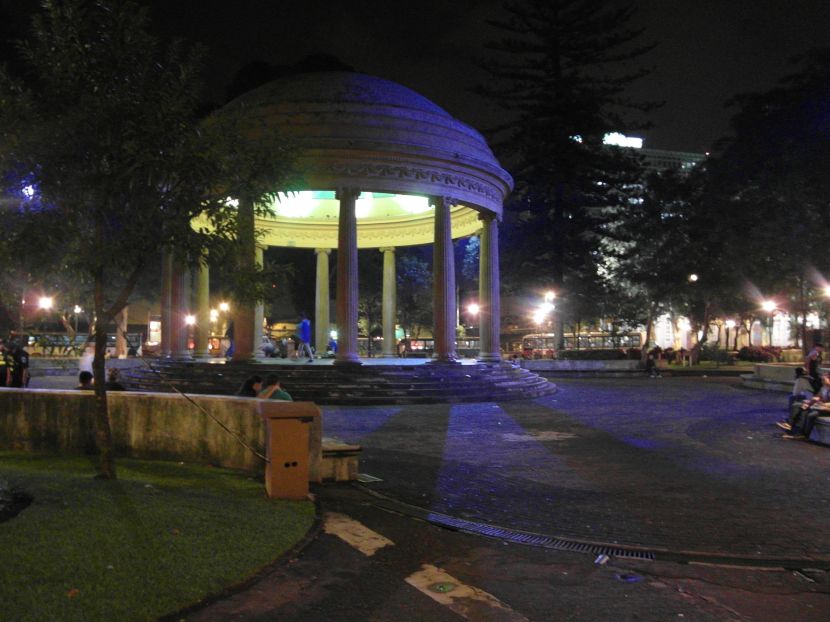
Later in the evening when the sun had already started to lighten other continents, I passed by the same park on my way back to the hotel. Gone were the happy youthful people with their skateboards and juggling balls. Instead, an ominous group consisting of prostitutes, pimps and drug-dealers seemed to have taken over the place. In fact, it looked exactly like a place where a western tourist like me finds himself facing a knife or a gun and quickly surrenders all his valuables. I turned around looking as confident as possible and took the next available taxi and got safely to my bed. My hotel was only a few blocks away from the center but the locals as well as my travel senses advised me to take a taxi always in the evening.
The possibility of being robbed was all too much present in many areas of San José. For a guy like me, who is used to live in Finland where armed robberies are relatively unheard of, such constant sense of fear would have a strong negative effect on one’s well-being. Safety is among the most basic needs of humans so disturbances in one’s sense of safety ought to have a remarkable negative impact on one’s happiness. How could they be happy if they always have to be careful and vigilant in the streets to avoid robbery?
Ease of living and religion on the one hand, criminality and unsafeness on the other, the mystery behind Costa Rican happiness had found its first dimensions. I felt sure that I would crack the mystery of Costa Rican happiness in no time…
Dios te ama – God loves you! With these words I was greeted into Costa Rica after my long flight. The mystery about Costa Rica that I travelled across the Atlantic to solve is about happiness. According to different polls, namely, Costa Ricans are a happy bunch of people. In Gallup’s much quoted Global Well-being survey, Costa Rica ranks sixth, far above what would be expected in terms of its economic situation – and far above such countries as United States, Britain or Germany. The other countries in the top five – Denmark, Sweden, Norway, Netherlands and Finland – are among the richest and most economically equal societies in the world so their success is easy to understand but Costa Rica seems to have produced almost the same amount of happiness with far smaller Gross Domestic Production. In addition, if we combine life satisfaction with measures of the ecological footprint like Happy Planet Index has done, Costa Rica comes out as number one in the world.
Another cultural anomaly coming through in statistics is the fact that in Hofstede’s cultural dimension of ’masculinity versus femininity’ Costa Ricans rank – unlike other Latin American countries with their machismo image – among the countries with the most feminine values (interestingly, the top six countries in both the well-being survey and Hofstede’s femininity dimension are exactly the same. Could this be a mere coincidence?). The shortcomings of these self-reporting surveys are of course well-known and it might be disputed whether they tap into happiness at all. But at least it can be stated that there is something interesting and unique going on in Costa Rica in terms of cultural valuations and happiness.
But back to the park Morazán in the centre of San José in which I sat relaxing after the long flight drinking an ice tea. The park alone offered me three different insights into Costa Rican happiness. Firstly, the greeters with a message from God were young Salvation Army members who invited me to their church. Naturally, I accepted the invitation despite the almost total language barrier between us. More of that later. But their mere presence in the park reminded me of the strong influence religion has in this country and in these people’s lives. Religion has been found on average to increase people’s happiness within the nations so perhaps religiousness was one building block in Costa Rican happiness.
I found the second key to explain Costa Rican happiness whilst observing the other people in the park. Certain easiness of being characterized the faces of these people who hanged there with no hurry whatsoever. In contrast to us northerners who always are a bit tense and on our way to the next achievement, these people seemed to be completely at home in wasting away a proper working day in the park. More about this theme in the next post but I believe that in this attitude of not taking one’s achievements too seriously one can find much potential for better well-being.
Later in the evening when the sun had already started to lighten other continents, I passed by the same park on my way back to the hotel. Gone were the happy youthful people with their skateboards and juggling balls. Instead, an ominous group consisting of prostitutes, pimps and drug-dealers seemed to have taken over the place. In fact, it looked exactly like a place where a western tourist like me finds himself facing a knife or a gun and quickly surrenders all his valuables. I turned around looking as confident as possible and took the next available taxi and got safely to my bed. My hotel was only a few blocks away from the center but the locals as well as my travel senses advised me to take a taxi always in the evening.
The possibility of being robbed was all too much present in many areas of San José. For a guy like me, who is used to live in Finland where armed robberies are relatively unheard of, such constant sense of fear would have a strong negative effect on one’s well-being. Safety is among the most basic needs of humans so disturbances in one’s sense of safety ought to have a remarkable negative impact on one’s happiness. How could they be happy if they always have to be careful and vigilant in the streets to avoid robbery?
Ease of living and religion on the one hand, criminality and unsafeness on the other, the mystery behind Costa Rican happiness had found its first dimensions. I felt sure that I would crack the mystery of Costa Rican happiness in no time…
Leaving home and learning to appreciate what we have
The hardest part of a journey is usually the start. This is true in two senses of the word: Firstly, there are always so many excuses not to travel – the lack of money, risks ahead, study, work or family commitments and so forth – that many people never leave their home. These are obstacles that can always be arranged, if one just has a strong enough vision. Don’t take my word for it, ask Dervla Murphy who in addition to bicycling alone from Ireland to India in 1963 also travelled 1500 miles by foot in Peru with her nine-year old daughter. It must though be noted that her daughter Rachel rode the first six hundred miles with a pony before becoming a pedestrian.
Secondly, leaving is hard because one has to say farewell to so many dear people whom one doesn’t see for months. The last weeks before the trip are always filled with sad partings in which both realize how long it will be before we meet again. Should one say some kind words – or just shake hands in silence with a manly firmness? These are moments I have never learned to handle with elegance, I am always a bit unsure of how to get through them and how to really show the other how much I care about him or her.
One of the main reasons to travel, however, are precisely these good-byes. The human psychology is built in such a way that we often are unable to appreciate that which we have. We grow so used to having the good people around us and getting their attention and love that we start to take it for granted. We no longer see how much their presence really gives to us and in how many ways they enrich our lives. You do not learn to appreciate something before you don’t have it – and traveling is a way of departing from that which you have for a while and thus learn to appreciate it anew.
This is connected to one of the things that modern well-being psychologists have emphasized, namely the fact that in terms of happiness, ”the human mind is extraordinarily sensitive to changes in conditions, but not so sensitive to absolute levels” as Jonathan Haidt puts it. In other words, most of the things we have – especially our material wealth – don’t affect our happiness in the long term because we grow used to them. To change our happiness permanently we should not change the amount of things we have but our relation to the things we have. One can learn oneself to take a more appreciative attitude towards one’s life – for example through the simple exercise of once a week writing down five things one is gratetuf for. Simple as it may sound, this kind of exercises have been found to increase people’s satisfaction with life, their optimism and even their physical health.
Traveling – I argue – is one of the best ways to learn to appreciate more what one already has. As the travel writer Paoul Theroux notes: ”One of the greatest rewards of travel is the return home to the reassurance of family and old friends, familiar sights and homely comforts and your own bed.” But to get there, you first have to travel.The hardest part of a journey is usually the start. This is true in two senses of the word: Firstly, there are always so many excuses not to travel – the lack of money, risks ahead, study, work or family commitments and so forth – that many people never leave their home. These are obstacles that can always be arranged, if one just has a strong enough vision. Don’t take my word for it, ask Dervla Murphy who in addition to bicycling alone from Ireland to India in 1963 also travelled 1500 miles by foot in Peru with her nine-year old daughter. It must though be noted that her daughter Rachel rode the first six hundred miles with a pony before becoming a pedestrian.
Secondly, leaving is hard because one has to say farewell to so many dear people whom one doesn’t see for months. The last weeks before the trip are always filled with sad partings in which both realize how long it will be before we meet again. Should one say some kind words – or just shake hands in silence with a manly firmness? These are moments I have never learned to handle with elegance, I am always a bit unsure of how to get through them and how to really show the other how much I care about him or her.
One of the main reasons to travel, however, are precisely these good-byes. The human psychology is built in such a way that we often are unable to appreciate that which we have. We grow so used to having the good people around us and getting their attention and love that we start to take it for granted. We no longer see how much their presence really gives to us and in how many ways they enrich our lives. You do not learn to appreciate something before you don’t have it – and traveling is a way of departing from that which you have for a while and thus learn to appreciate it anew.
This is connected to one of the things that modern well-being psychologists have emphasized, namely the fact that in terms of happiness, ”the human mind is extraordinarily sensitive to changes in conditions, but not so sensitive to absolute levels” as Jonathan Haidt puts it. In other words, most of the things we have – especially our material wealth – don’t affect our happiness in the long term because we grow used to them. To change our happiness permanently we should not change the amount of things we have but our relation to the things we have. One can learn oneself to take a more appreciative attitude towards one’s life – for example through the simple exercise of once a week writing down five things one is gratetuf for. Simple as it may sound, this kind of exercises have been found to increase people’s satisfaction with life, their optimism and even their physical health.
Traveling – I argue – is one of the best ways to learn to appreciate more what one already has. As the travel writer Paoul Theroux notes: ”One of the greatest rewards of travel is the return home to the reassurance of family and old friends, familiar sights and homely comforts and your own bed.” But to get there, you first have to travel.
The beginning of a journey
Sometimes a man has to go. Sometimes a man needs a purpose to go. I am going to Central America, to Costa Rica and Nicaragua. The purpose of my journey is to learn more about the local culture, the way they live their lives and the way they think about vital issues such as happiness, morality and good life.
What makes Costa Ricans happy, what is their measure of success? What kind of attitudes do Nicaraguans have towards life’s big issues: family, work, friendship and death? What kind of things do they value, what is sacred for them? And of course: What can we learn about our own lives and our own deeply-held values and attitudes by comparing them with the Central-American culture? In other words, what can we learn from them in terms of how to live a good life ourselves? These are the questions I will be examining.
My mission in life is to explore novel ways of thinking that enable people to better understand how to live their life in a good way. I aim to find fruitful ways to answer the ancient question about what is good life and how to live one’s life. The journey I will now be taking is a part of this mission. Through absorbing myself to the Central American culture for a couple of months I hope to widen my perspective and thus be able to think about these basic questions in a more open and wide-reaching way.
This blog will be a report of this journey. I hope to give the reader two things: (1) To broaden her or his perspective about what good life could be about. (2) To give practical insights into how to live a better life within one’s own life-situation, whatever that situation is.
How then to live your life? Truth to be told, there is no such thing as one correct way of living. Everyone must carve their own path. As Zarathustra said:
”This is just my way, where is yours?” Thus did I answer to those who asked me ”the way.” For the way – it does not not exist!
Sometimes a man has to go. Sometimes a man needs a purpose to go. I am going to Central America, to Costa Rica and Nicaragua. The purpose of my journey is to learn more about the local culture, the way they live their lives and the way they think about vital issues such as happiness, morality and good life.
What makes Costa Ricans happy, what is their measure of success? What kind of attitudes do Nicaraguans have towards life’s big issues: family, work, friendship and death? What kind of things do they value, what is sacred for them? And of course: What can we learn about our own lives and our own deeply-held values and attitudes by comparing them with the Central-American culture? In other words, what can we learn from them in terms of how to live a good life ourselves? These are the questions I will be exploring.
My mission in life is to explore novel ways of thinking that enable people to better understand how to live their life in a good way. I aim to find fruitful ways to answer the ancient question about what is good life and how to live one’s life. The journey I will now be taking is a part of this mission. Through absorbing myself to the Central American culture for a couple of months I hope to widen my perspective and thus be able to think about these basic questions in a more open and wide-reaching way.
This blog will be a report of this journey. I hope to give the reader two things: (1) To broaden her or his perspective about what good life could be about. (2) To give practical insights into how to live a better life within one’s own life-situation, whatever that situation is.
How then to live your life? Truth to be told, there is no such thing as one correct way of living. Everyone must carve their own path. As Zarathustra said:
”This is just my way, where is yours?” Thus did I answer to those who asked me for ”the way.” For the way – it does not not exist!
 Frank Martela
